"A quote that I will never mention again or explain and will simply expect you to accept its profundity"
— Every Epigraph Writer
The performative nature of this opening echoes the performative nature of most epigraph usage. You open a book eager to dive into a new story, fictional or not, and your immediate first impression is an out of context quote. You may know the title of the book or its premise but you lack the same context as the author.
The author knows where the quote is going but the reader is new and does not share that model of the world. When an author assumes too much about their reader, this called the curse of knowledge bias. Authors don't know what it's like to not know why this quote is important, and it leaves them blind to their readers predicament. But that is no excuse.
This quote is called an epigraph. The Oxford dictionary says an epigraph is intended to suggest its theme. Suggest is the right word. Epigraphs do not inform or explain, they merely propose, and whether you can take that proposal into consideration depends entirely on what you already know.
Consider this worst offense, the epigraph before T.S. Eliot's The Waste Land.
“Nam Sibyllam quidem Cumis ego ipse oculis meis
vidi in ampulla pendere, et cum illi pueri dicerent:
Σίβυλλα τί θέλεις; respondebat illa: ἀποθανεῖν θέλω. For Ezra Pound
il miglior fabbro"
— T.S. Eliot, The Waste Land
This is pure performance. Eliot showing his erudition and connection to Ezra Pound. It's like speaking a language only you and your friend know in front of the group. It's rude and pretentious. Even translated this quote is an obscure reference to Petronius's Satyricon that expects the reader to do the work Eliot did not want to do: to make the connection between Satryricon and The Waste Land. He failed to communicate. Sign a hardcover copy to Ezra next time, Eliot.
This is arrogance. The author assumes the reader will find the same profundity in the quote and revere them for choosing it. But this is wishful thinking. Without context the epigraph evaporates, remembered by almost no one. The rare reader who circles back hoping to unlock some deeper meaning often discovers the quote has no clear relationship to the work it precedes.
That Eliot quote was cherry picked as a totem of the worst offender but even if I go through some recent books in my Kindle library I find many epigraphs without useful context.
"The Irish Republic is entitled to, and hereby claims, the allegiance of every Irishman and Irishwoman. The Republic guarantees religious and civil liberty, equal rights and equal opportunities to all its citizens, and declares its resolve to pursue the happiness and prosperity of the whole nation and of all its parts, cherishing all of the children of the nation equally.’ Excerpt from ‘The Proclamation of the Irish Republic’, 1916"
— Claire Keegan, Small Things Like These
Keegan gives her reader a running start, assuming they already know the book is set in Ireland. But it only coheres if that is true and even then, retroactively, once you've discovered the story is about these rights being systematically violated. The epigraph adds nothing to the beginning of the story.
"It is easier to try to be better than you are than to be who you are." – MARION WOODMAN
"Is there life before death? That is the question!" – ANTHONY DE MELLO
— Oliver Burkeman, Meditations for Mortals
Here's a non-fiction example. The dual epigraphs set the tone. They're suggestive with their two counterintuitive arguments that, first, trying is easier than being and, second, that life before death—something knowable—is more important than life after death—something unknowable. They create a productive tension but leave you waiting for Burkeman to explain them.
He never does. Yet non-fiction readers are paying for exactly that, for someone to take interesting ideas and explain, synthesize and interpret them. Leaving two of them sitting unexplained on the first page is the last thing you would expect.
"Don’t let anyone rob you of your imagination, your creativity, or your curiosity. It’s your place in the world; it’s your life. Go on and do all you can with it, and make it the life you want to live. —Mae Jemison, American engineer, physician, and former NASA astronaut."
— Anne-Laure Le Cunff, Tiny Experiments
If Eliot's epigraph was too obscure, Le Cunff's is too obvious. This is pure platitude with its vague imperative ("Don't let anyone robe you") and obvious statements dressed up as wisdom ("it's your life"). It could have been said by anyone. This fits well in a greeting card for graduation, a motivational poster or LinkedIn post. It's only here due to the halo effect, where one positive quality (being an astronaut) makes us assume other positive qualities (giver of wise advice).
"The cattle are lowing, The Baby awakes. But the little Lord Jesus No crying He makes."
— Kurt Vonnegut, Slaughterhouse Five
This Vonnegut epigraph like the others offers nothing. An unsettling Christmas carol before a novel about firebombing creates a sense that it must mean something, but what that meaning may be is not obvious. It is an epigraph that announces itself and then evaporates.
Alright, so do we bury them 6ft under?
The title of this post recommends a strong correction to leave an epitaph to epigraphs, to give them a farewell, impress them into the ground, not into readers. That is understandably extreme though Im not opposed.
Epigraphs can be useful. The simplest fix is also the most obvious one. Explain the epigraph. What follows are three ways authors have done this well.
First, use the epigraph to explain the title of the book
Here is an epigraph that bridges the title on the cover of the book with the story within, explaining the title, providing an insightful etymological fact and impressing the important meaning of the title.
"'The Weyward Sisters, hand in hand, Posters of the sea and land, Thus do go, about, about, Thrice to thine, thrice to mine, And thrice again to make up nine. Peace, the charm’s wound up.' — Macbeth
Weyward is used in the First Folio edition of Macbeth. In later versions, Weyward was replaced by Weird."
— Emilia Hart, Weyward
Second, use the epigraph to introduce a new section
"'Although many of us may think of ourselves as thinking creatures that feel, biologically we are feeling creatures that think.' — Dr. Jill Bolte Taylor, Neuroscientist"
— Jonice Webb, Running on Empty
At the start of "Chapter 6 Why Feelings Matter and What to Do with Them" Webb opens with this epigraph, which offers clever insight, explains concisely the question the chapter suggests to answer while leaving you waiting to find out what that answer will be.
Third, use the epigraph to explain the premise:
This epigraph from Max Porter's Grief Is The Thing with Feathers communicates that "thing with the feathers" is going to be a crow and that the crow seems to stand for love.
This is admittedly an imperfect example. It provides more detail about the title, but is not completely apparent. Porter never returns to or explains the epigraph, and unlike the epigraph in Weyward this one lacks the clear self-explanatory nature for its existence. Yet, it's not entirely isolated from the text and is apparent to the reader how it connects to the story.
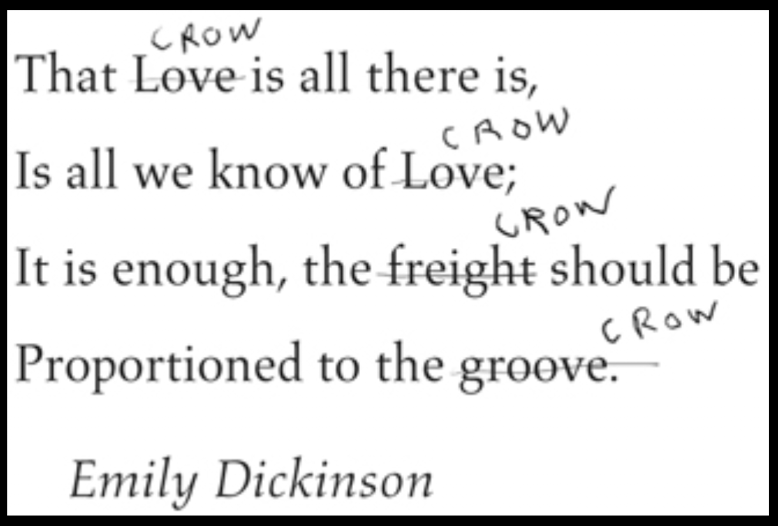
— Max Porter, Grief Is the Thing with Feathers
Getting Off With A Warning
Epigraphs' prominent position demands better use than as resting places for stray thoughts and displays of erudition. Every epigraph needs an explanation. The author must provide their interpretation of the quote, why they included it, what it is driving towards.
This pushes back against the idea of leaving things up to interpretation, which more often than not reflects an author too lazy to explain clearly or too indecisive to choose a side. Ambiguity can lead to productive debate but a book's first page is not the place for it. There is no shared context yet from which debate can start.
Epigraphs do not need to be at the beginning. The author can weave the explanation into the flow of the work instead of producing a explanation at the start. Bring the suggested theme back into the forefront to reiterate the argument and remind the reader of the theme like the familiar few notes of a leit motif.
Or revisit the epigraph throughout the text and explain it at the ending with the epigraph's sibling the epilogue. The author presents the epigraph at the start to give the reader a mystery of unknowing, gradual knowing as they read, to full knowing and checking their understanding at the end.
Simply choosing an epigraph and leaving it there at the start for the reader to be enlightened is no effort and therefore no effect. It's the wishful thinking of poor communicators who believe that of course the person will get it because I get it.